

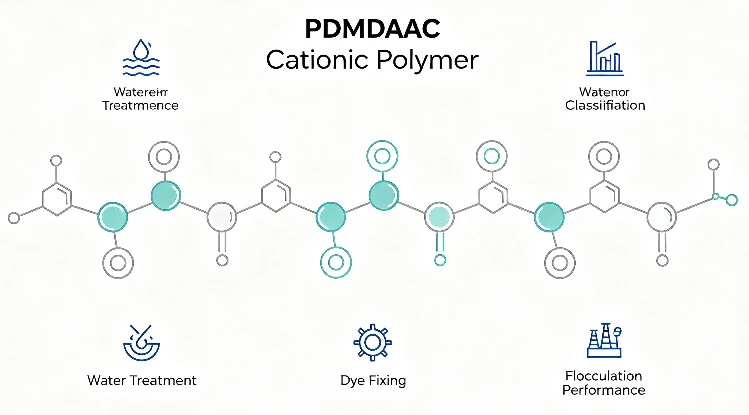
Poly(dimethyldiallylammonium chloride)-commonly known as PDMDAAC-is a versatile cationic polymer widely used in water treatment, wastewater clarification, textile dye fixing, and many other industrial applications . Its unique quaternary ammonium structure gives it a permanent positive charge, making it highly effective at neutralizing negatively charged particles and pollutants.
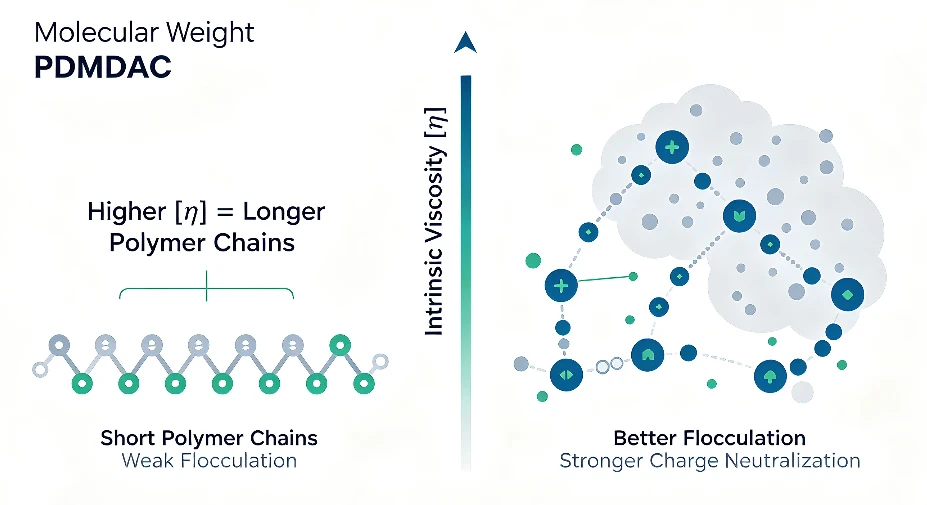
But here's the challenge: molecular weight matters greatly. Higher molecular weight PDMDAAC delivers superior performance-better flocculation, stronger charge neutralization, and more efficient treatment . However, achieving consistently high molecular weight has been a persistent manufacturing challenge.
Recent research from the Nanjing University of Science and Technology sheds light on a critical factor that many producers overlook: the maintaining temperature and reaction time during polymerization . Understanding this relationship is the key to producing PDMDAAC with record-high molecular weight.
The Science Behind the Process
Why Molecular Weight Matters
Intrinsic viscosityserves as a practical indicator of molecular weight. The higher the value, the larger the polymer chains, and the better the performance in applications like:
Water clarification:
Stronger bridging between particles
Sludge dewatering:
Faster separation and higher solids content
Dye fixing:
Better binding to fabric surfaces
The Temperature-Time Relationship
The research investigated how the final maintaining temperature (T3) and its corresponding holding time (t) affect the product's intrinsic viscosity and monomer conversion rate .
Key findings demonstrate a clear pattern:
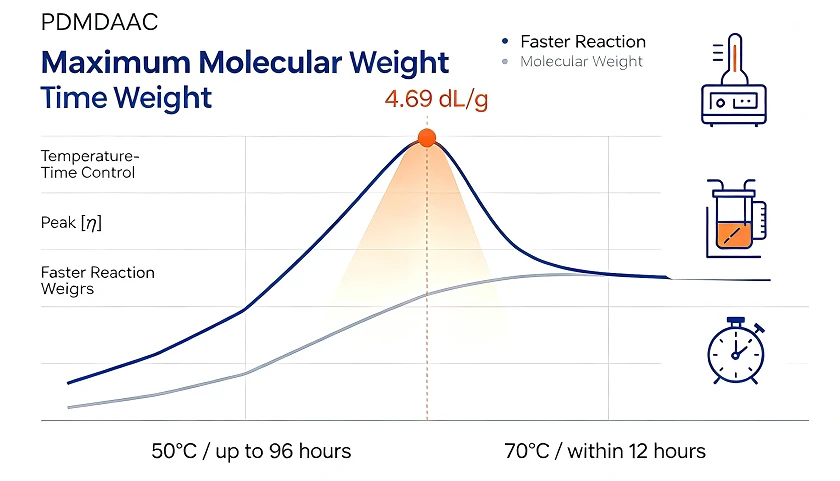
Lower T3 (e.g., 50°C): Requires longer reaction time (up to 96+ hours) to achieve maximum molecular weight
Higher T3 (e.g., 70°C): Reaches peak molecular weight much faster (within 12 hours)
Optimal balance: The highest recorded [η] of 4.69 dL/g was achieved at T3 = 55°C for 96 hours
This represents the highest intrinsic viscosity value ever reported for PDMDAAC prepared using a chemical initiation method, corresponding to a weight-average molecular weight (Mw) of 4.169 × 10⁶ .
Why This Happens
The polymerization process unfolds in two stages:
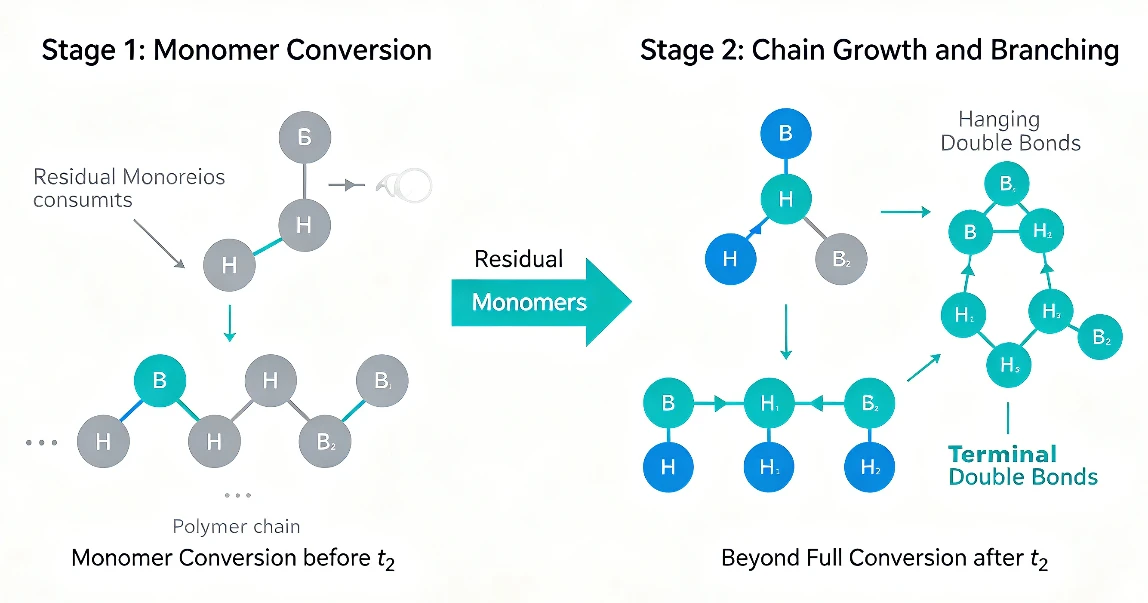
Stage 1 – Monomer Conversion (before t₂): During this phase, residual monomers are polymerized. As conversion approaches 100%, molecular weight increases steadily.
Stage 2 – Beyond Full Conversion (after t₂): Once monomer conversion reaches 100%, further molecular weight growth occurs through polymerization of "hanging" double bonds and terminal double bonds. This creates branched and eventually crosslinked structures .
However, there's a downside to over-extending the reaction. When maintained too long after reaching 100% conversion, excessive branching and crosslinking occur, leading to:
| Property | Linear PDMDAAC | Crosslinked PDMDAAC |
|---|---|---|
| Intrinsic Viscosity [η] | 4.69 dL/g | 0.47 dL/g (apparent) |
| Solubility | Dissolves completely | Swells, largely insoluble |
| Dissolution Time | Slow but complete | Never fully dissolves |
| Thermal Stability | Lower degradation onset | Higher thermal stability |
Implications for Manufacturing
Production Efficiency
This research provides actionable guidance for manufacturers:
Select the right T3 based on your production schedule:
For faster throughput: Higher temperatures (60-70°C) complete the reaction in 9-24 hours
For maximum molecular weight: A lower temperature (55°C) with extended time (96 hours) produces the highest [η]
Monitor conversion carefully:
Stopping too early leaves residual monomer (Conv. < 100%), reducing molecular weight
Stopping too late triggers crosslinking, dramatically reducing solubility and effective molecular weight

Know your product goals:
Linear, high-solubility PDMDAAC is ideal for water treatment applications
Slightly crosslinked PDMDAAC can offer enhanced thermal stability and special properties for textile applications
Quality Control Considerations:
The study also revealed that the solubility test is a simple but powerful quality indicator. When a PDMDAAC product dissolves slowly or leaves insoluble fragments, it signals unwanted crosslinking. Linear products dissolve completely-though high-molecular-weight linear products may take longer to fully dissolve .
Conclusion
Producing high-performance PDMDAAC requires precision in both temperature control and timing. The research demonstrates that:
- A clear trade-off exists between reaction speed and maximum achievable molecular weight
- The optimal condition (55°C for 96 hours) yields record-high [η] of 4.69 dL/g
- Exceeding the optimal time triggers crosslinking, reducing solubility and effective molecular weight
For manufacturers seeking to produce the highest-quality PDMDAAC, understanding and controlling this temperature-time relationship is not just a technical detail-it's the key to competitive advantage. By fine-tuning these parameters, producers can deliver products with superior performance in water treatment, textile processing, and other demanding applications.
The research also highlights the importance of monomer purity as a foundation for achieving high molecular weight . With both pure raw materials and optimized process control, manufacturers can consistently produce PDMDAAC that meets the highest industry standards.